
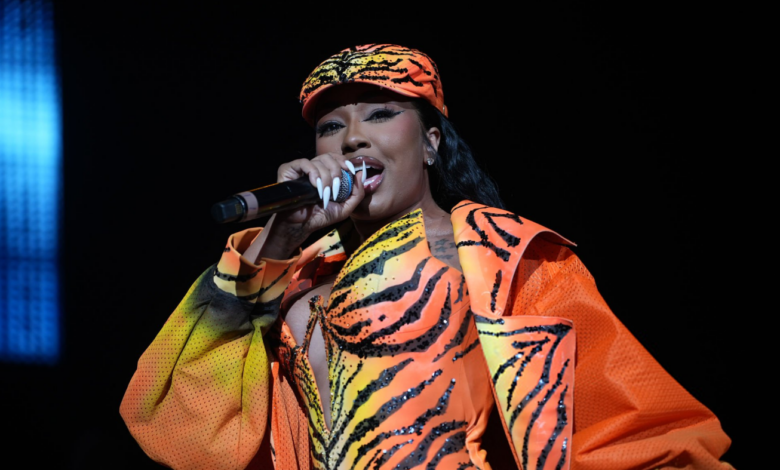
The tension was palpable when Yung Miami sat down with Lore’l for a recent interview that quickly turned into a discussion about criticism, career choices and the challenges of establishing herself as a solo artist. The conversation revealed that Miami has been paying attention to the negative comments made about her in the media, particularly when her name comes up on the radio. While Lore’l defended her position as a media personality who discusses public figures, Miami made it clear that some of the commentary had started to feel personal. The exchange comes at a significant point in Miami’s career as she works to build her identity outside the City Girls and establish herself as a solo performer. With her new album, WATCH DIS, serving as part of this new chapter, the rapper appears determined to confront those who have questioned her talent, decisions and staying power in the music industry.
Yung Miami, whose real name is Caresha Brownlee, rose to prominence as one half of the hip-hop duo City Girls alongside JT. The group gained attention for its energetic music, bold personalities and unapologetic approach to themes of money, relationships and independence. Their success helped establish them as recognizable figures in contemporary hip-hop, with both members developing individual fan bases and public profiles. However, the group’s period of prominence has given way to a different phase in which each artist must navigate her career independently. As Yung Miami pursues solo opportunities, the level of public interest surrounding her music and career has become an important part of the conversation about her next move.
The transition from a successful group to a solo career can be difficult, particularly when audiences have become accustomed to seeing two artists work together. Yung Miami now faces the challenge of showing listeners what she can accomplish without the established identity and shared momentum of City Girls. Although she has continued pursuing music and other professional opportunities, questions about her ability to maintain the same level of attention have followed her into this new phase. Some listeners remain interested in what she can deliver as an individual artist, while others have expressed doubts about the direction of her solo career. These differing reactions have created an environment in which every release, interview and public appearance can become another opportunity for critics to evaluate her progress.
Her debut solo album, WATCH DIS, arrives against this backdrop of heightened scrutiny and divided opinions. Rather than allowing criticism to remain a conversation happening around her, Miami appears ready to address it directly through her public statements and artistic choices. The album’s title also became part of her exchange with Lore’l, as Miami connected the radio host’s previous remarks to the broader criticism she has experienced. Although the reception surrounding the project has not generated universal enthusiasm, Miami’s determination to prove herself gives the release a personal dimension beyond its music. Her challenge is to turn that determination into a project that connects with listeners and demonstrates what she can offer as a solo artist.
During the interview, Miami confronted Lore’l about the negative commentary she believed the radio host had repeatedly directed toward her. She explained that she notices whenever her name comes up on a particular radio station and Lore’l has something critical to say. Miami described the experience of hearing these comments and questioning why the same person seemed to have a negative opinion whenever a story about her emerged. She also suggested that Lore’l was among the people she had in mind when choosing to emphasize the WATCH DIS concept. Her remarks made it clear that she was not simply discussing criticism in general, but addressing a specific media personality whose opinions had caught her attention.
One of the most revealing aspects of Miami’s comments was her suggestion that the criticism follows her beyond the entertainment industry. She explained that she becomes aware of the commentary even while handling everyday responsibilities, including dropping her children off at school. This detail added a personal dimension to the disagreement because it showed how public discussion can affect the way a celebrity experiences ordinary life. For Miami, the issue appeared to extend beyond whether a radio host approved of her music or career decisions. She seemed frustrated by what she perceived as a recurring pattern of negativity, especially when those opinions became part of the wider conversation surrounding her name.
Lore’l responded by explaining that discussing public figures is part of her job as a radio personality. Entertainment hosts regularly analyze celebrity decisions, music releases and public controversies, often offering opinions that do not always align with the people being discussed. From Lore’l’s perspective, criticism does not automatically mean that a personal conflict exists. She also maintained that she did not believe she spoke negatively about Miami all the time, although she acknowledged making comments that might not have been flattering. Her response reflected a familiar tension between celebrities who experience commentary as personal criticism and media personalities who view it as part of their professional responsibilities.
The conversation became more pointed when Miami continued to challenge Lore’l’s explanation. Their disagreement appeared to involve more than a single remark, with Miami referring to previous commentary about her professional decisions. One example concerned Lore’l’s reaction to Miami dropping out of Bossman D-Low’s tour during the period when the song “Spend Dat” was gaining attention. Lore’l had reportedly suggested that Miami acted as though she was bigger than the program, a characterization that Miami seemingly viewed as unfair. Although the two women did not agree on how to interpret the situation, the exchange demonstrated how comments about a celebrity’s business decisions can influence the relationship between that person and the media.
The disagreement over the tour also highlights the difficult balance artists must strike between pursuing new opportunities and meeting existing professional commitments. When a performer experiences growing attention from a song or another project, decisions about touring, promotion and scheduling can become more complicated. Outsiders may interpret a change in plans as evidence of arrogance or misplaced priorities, while the artist may have reasons that are not fully understood by the public. Without complete information about the circumstances surrounding Miami’s departure from the tour, it would be unfair to treat either interpretation as the definitive explanation. What is clear from the interview is that the earlier commentary remained relevant enough for Miami to bring it up during their face-to-face conversation.
Lore’l insisted that her comments were not intended to be personal, but Miami appeared unconvinced. That difference in perspective became the central issue of the interview, with both women approaching the situation from different professional positions. A media personality may believe she is offering an ordinary opinion about a public figure, while the person being discussed may interpret repeated negative remarks as a pattern of targeted criticism. Neither perspective necessarily resolves the disagreement, particularly when both parties remember earlier exchanges differently. Their conversation therefore offered a glimpse into the complicated relationship between celebrity culture, entertainment journalism and the public figures who depend on media exposure to promote their work.
For Yung Miami, the timing of the exchange is particularly important because she is trying to define her identity during a period of career change. Her association with City Girls remains a major part of her public image, but her solo work requires audiences to evaluate her on different terms. The attention surrounding WATCH DIS could help introduce her music to listeners who have followed her mainly through the group, although criticism may also influence how some people approach the project. Public disagreements can generate additional interest in an album, but attention alone does not guarantee commercial success or long-term audience loyalty. Miami ultimately needs listeners to connect with the music itself if she wants her solo career to develop beyond the conversation surrounding her personality and public disputes.
Her willingness to address criticism directly may nevertheless prove significant in shaping her next chapter. Rather than presenting herself as unaffected by negative opinions, Miami acknowledged that she notices what people say and remembers who has made particular comments. This openness gives her an opportunity to communicate her frustrations while showing that she remains invested in her own career. It also creates risks, because public confrontations can shift attention away from an artist’s work and toward disputes that may be difficult to resolve. The challenge for Miami is to use the attention constructively and demonstrate that her determination extends beyond responding to critics.
The interview also raises questions about the responsibilities of entertainment media in an environment where celebrity commentary can quickly become personal. Radio hosts and commentators have an established role in discussing music, public behavior and industry developments, and disagreement is an expected part of that work. However, the frequency, tone and context of those discussions can affect how the subjects perceive them. Celebrities also benefit from public attention, making it difficult to separate legitimate criticism from comments they simply dislike. The exchange between Miami and Lore’l illustrates why clear communication matters, even when neither person agrees with the other’s interpretation of events.
Ultimately, the tension between Yung Miami and Lore’l reflects a broader turning point in Miami’s career as she moves forward from the City Girls era and works to establish herself as a solo artist. Her confrontation with Lore’l showed that she remains aware of the doubts surrounding her music, her professional choices and her ability to sustain public interest. Lore’l, meanwhile, maintained that her commentary was part of her job rather than a personal attack, leaving the two women with different understandings of the same history. WATCH DIS now carries an additional layer of context because Miami has connected her new musical chapter with her determination to challenge those who underestimate her. Whether that motivation translates into lasting success will depend on the strength of her music, her ability to connect with listeners and the direction she takes from here.