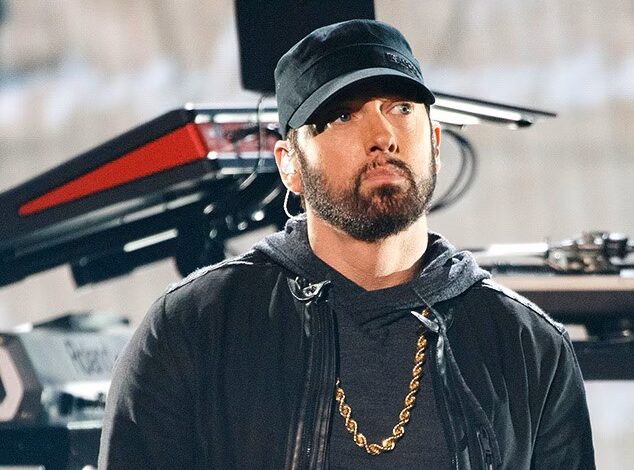
Eminem is facing criticism from disappointed fans following his collaboration with Kid Rock on “Heal My Faith,” a track featured on the album “Halfway 2 Jesus.” The controversy centers on more than the music itself. It has reopened questions about Eminem’s political beliefs, his public statements against Donald Trump and his decision to work with a musician who strongly supports the MAGA movement. For many listeners, the collaboration creates a conflict between the values Eminem has expressed publicly and the message he appears to be sending by working with Kid Rock. The reaction has been especially strong because Eminem previously challenged his fans to take a clear position on Trump and the politics surrounding his presidency. Now, with “Heal My Faith” bringing the two Detroit artists together again, some fans feel that Eminem is backing away from the political stance that helped define his public image.
The controversy draws heavily on Eminem’s October 2017 freestyle for the BET Hip Hop Awards, in which he delivered a pointed message about Donald Trump and his supporters. During the performance, Eminem made it clear that he expected his fans to consider where they stood politically. He rapped, “And any fan of mine who’s a supporter of his / I’m drawing in the sand a line, you’re either for or against.” The lyrics were widely understood as a direct challenge to fans who supported Trump, placing political disagreement at the center of Eminem’s relationship with his audience. Rather than treating politics as a subject separate from his music, the rapper used his platform to make his position unmistakable. That moment continues to shape how some listeners interpret his decisions, including his latest collaboration with Kid Rock.
Eminem’s political statements did not end with his 2017 freestyle. Over the years, he continued to express opposition to Trump and became increasingly associated with Democratic political figures and causes. In 2024, he publicly supported Kamala Harris during her presidential campaign, reinforcing the political direction many fans had come to associate with him. His statements and endorsements helped strengthen the perception that his opposition to Trump was more than a temporary disagreement. For listeners who viewed Eminem’s music as an expression of his personal convictions, those actions carried significance beyond celebrity politics. They also created expectations about the company he would keep and the projects he would choose to support.
Kid Rock represents a particularly sensitive figure in this debate because of his outspoken support for Trump and his identification with conservative American politics. Like Eminem, he comes from the Detroit music scene and built a successful career by combining elements of rap, rock, country and other popular genres. The two artists also share a history that stretches back to their early careers, when their paths crossed within Michigan’s music community. Their connection predates many of the political divisions that now shape public discussions about American entertainment. For Eminem, collaborating with Kid Rock may represent a return to an old friendship and a recognition of their shared musical background. For some fans, however, that history does not erase the political differences that have become central to both artists’ public identities.
The song “Heal My Faith” reportedly addresses the long relationship between the two musicians and frames their connection in personal rather than political terms. Eminem’s contribution emphasizes the idea that Kid Rock remains his brother despite their differences, presenting friendship as something that can survive disagreement. That message appears to be central to the track’s meaning and helps explain why Eminem was willing to participate. From his perspective, the collaboration may be an attempt to separate a personal relationship from the political beliefs associated with each artist. Yet that distinction has not satisfied everyone who has followed his career. Some fans believe that a friendship can remain private without requiring a public musical collaboration, particularly when that collaboration could be interpreted as an endorsement of someone whose politics conflict with their own.
The backlash intensified when Eminem promoted “Heal My Faith” on social media, including Instagram, and offered an explanation for his decision to work with Kid Rock. His caption read, “Not about choosing sides, just choosing to make music with my old friend. Praying for all of us. #HealMyFaith @kidrock.” The statement appears intended to reassure listeners that the song is about friendship and music rather than political allegiance. However, for critics, the wording has created another point of disagreement. Some fans see a contradiction between Eminem’s earlier demand that supporters choose a side and his current insistence that making music with Kid Rock is not about choosing sides. Instead of resolving the controversy, the caption has prompted further questions about how he understands the relationship between personal loyalty, political principles and public responsibility.
One reason the reaction has been so strong is that Eminem’s earlier message left little room for ambiguity. His 2017 freestyle did not simply criticize Trump or question his policies. It also challenged fans to consider whether their political support was compatible with their admiration for Eminem. That approach made his position unusually direct and encouraged listeners to interpret his political beliefs as part of his public identity. When an artist draws such a clear boundary, audiences may expect that boundary to remain meaningful in later decisions. Eminem’s collaboration with Kid Rock now raises a difficult question for those fans: does the same standard apply when the political disagreement involves a longtime friend rather than an ordinary supporter? The tension between those two situations explains why the controversy extends beyond a single song.
Supporters of Eminem’s decision may argue that personal relationships should not be reduced to political labels. Two people can share a hometown, a musical history and years of personal experiences without agreeing on elections, political parties or government policy. From this perspective, “Heal My Faith” can be understood as a statement about loyalty and the ability to maintain a connection across ideological differences. Working with Kid Rock does not automatically establish that Eminem endorses every position his collaborator holds. Music has often brought together artists with different backgrounds, beliefs and personal values. Those who defend the collaboration may therefore view the backlash as an example of political divisions making it harder for people to maintain relationships with those who disagree with them.
Critics, however, argue that public collaborations carry meaning beyond the private intentions of the people involved. When two prominent musicians release a song together, they draw attention to each other’s work, introduce their audiences to one another and create opportunities for mutual promotion. That visibility can be interpreted as a form of public association, even when neither artist explicitly endorses the other’s political positions. In Eminem’s case, the criticism is amplified by his own history of making political statements and asking fans to take a stand. Some listeners are not necessarily demanding that he end every personal relationship with someone who supports Trump. Instead, they are questioning why he chose to turn that relationship into a public musical partnership and whether his explanation adequately addresses the apparent contradiction.
The phrase “not about choosing sides” has become especially important because it contrasts so directly with Eminem’s earlier lyrics. In 2017, he presented support for Trump as a dividing line that fans needed to confront. In promoting “Heal My Faith,” he appears to suggest that making music with an old friend should not be interpreted through the same political framework. Both positions can be understood in context, but they also create a tension that audiences are entitled to examine. A person can oppose a political leader while maintaining friendships with people who support that leader. The more difficult question is whether a public figure who has encouraged political accountability should expect fans to separate personal relationships from professional decisions when the circumstances become more complicated.
The controversy also demonstrates how an artist’s past statements can influence the reception of new music. A song that might otherwise be judged on its lyrics, production and emotional impact can become a broader debate about credibility and consistency. For longtime Eminem listeners, the response to “Heal My Faith” is shaped by years of following his career, his political commentary and his willingness to challenge audiences. The collaboration therefore carries a significance that goes beyond the musical relationship between two Detroit artists. It invites listeners to reconsider whether Eminem’s political principles should influence the projects he accepts and the people he chooses to promote. It also highlights the difficulty of maintaining a clear public position while navigating relationships that may not fit neatly into political categories.
Ultimately, the reaction to Eminem’s collaboration with Kid Rock reflects a clash between personal loyalty and public expectations. Eminem appears to view “Heal My Faith” as an opportunity to celebrate a longstanding friendship without turning the song into a political statement. Some fans accept that distinction, while others believe his earlier comments about Trump make the collaboration harder to defend. His social media caption has not ended the disagreement because it does not fully address the contradiction critics perceive between his past demands and his current approach. Whether the song succeeds as a musical reunion will depend on how listeners respond to the track itself, but the surrounding debate is likely to remain part of its reception. For Eminem, the challenge is not simply defending a collaboration with an old friend. It is explaining how that decision fits with the political principles he has publicly asked his fans to take seriously.