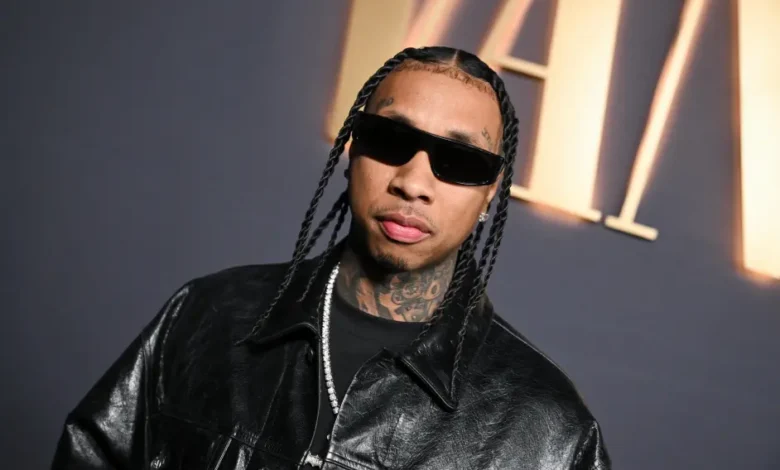
Tyga’s new album $TARFACE has become one of the most debated hip-hop releases of the summer, but the conversation has focused as much on artificial intelligence as it has on the music itself. The project was designed as a major creative departure for the veteran rapper, who adopted a new alter ego and leaned heavily into an 1980s-inspired sound and visual identity. Instead of receiving praise for the ambitious reinvention, Tyga has faced intense criticism from listeners and critics who question both the album’s execution and the role AI played in its creation. Pitchfork added significantly to the controversy by giving $TARFACE a rare 0.0 rating and delivering a harsh assessment of the project. Tyga has since pushed back, arguing that people have misunderstood his comments and wrongly concluded that he created an entire AI album.
The controversy gained momentum after Tyga publicly admitted that artificial intelligence was used during the production of $TARFACE. In an interview with VIBE, he explained that AI helped him create specific 1980s-inspired sounds, including synth elements and a guitar solo. He compared the technology to Auto-Tune, arguing that new tools often face resistance before artists learn how to incorporate them into their creative processes. Tyga also made it clear that he wrote the songs and performed the vocals himself. His comments were intended to explain how he approached the album, but they instead became a major source of criticism among listeners who believe AI should have a limited role in human music-making.
The issue became even more controversial after Pitchfork reviewed $TARFACE and gave it a 0.0 score. The publication’s August 12 review described the project in extremely negative terms and criticized its concept, production and overall execution. The review also connected the album’s sound to the growing debate over AI-assisted music, questioning the human quality of some of its performances and production choices. Pitchfork’s score attracted widespread attention because the publication had not issued a 0.0 rating in nearly two decades. While the review discussed Tyga’s AI use, its criticism was broader than simply penalizing him for using the technology, focusing heavily on what the reviewer considered an unconvincing and derivative album.
Tyga responded to the review with humor when he appeared on TMZ Live. Asked about Pitchfork’s assessment, he joked that he did not really know what Pitchfork was and associated the word with the devil. His response became more serious when the discussion turned to the claims that $TARFACE was an AI-generated album. Tyga argued that people had taken his admission about AI-assisted production and turned it into a much broader claim about how the entire project was made. He emphasized that he spent months working in the studio and that the technology did not replace his songwriting or vocal performances.
Tyga was particularly direct about the role he believes AI played in the project. He said that he used AI-assisted elements for certain sounds when he wanted to achieve a specific production effect quickly. According to his explanation, the technology was useful for creating some of the synths and guitar sounds that fit the album’s 1980s concept. He insists that the writing remained his and that all of the vocals were performed by him. That distinction has become central to his defense because Tyga believes there is a significant difference between using AI as a production tool and allowing artificial intelligence to generate an entire album.
The distinction matters because $TARFACE was always intended to be an experimental project. Tyga created a new persona and attempted to move away from the sound that defined much of his mainstream career. The album draws from 1980s synth-pop, disco and pop influences, making its production choices an important part of the overall concept. Tyga has previously said that he worked with vintage studio equipment and tried to recreate the warmth associated with recordings from that period. The decision to use modern AI technology alongside those retro influences created an unusual combination that some listeners viewed as innovative while others saw it as undermining the album’s attempt at authenticity.
Pitchfork’s criticism suggests that the problem was not simply the existence of AI in the production process. The review attacked what it considered the album’s lack of originality and emotional depth, while arguing that its 1980s influences were not handled convincingly. The critic also questioned the human quality of some of the album’s sounds and performances. From that perspective, AI became part of a larger criticism about whether $TARFACE successfully delivered the artistic transformation Tyga intended. The debate therefore extends beyond the question of whether AI should be allowed in music and into the more difficult question of whether the technology improved or weakened the finished product.
The album’s 1980s aesthetic has also received criticism from listeners who believe Tyga’s use of nostalgia feels calculated. The project was built around an elaborate concept that references a different era of music, fashion and pop culture. Nostalgic projects can succeed when artists use older influences to create something personal and distinctive, but audiences can also reject them when the references appear superficial. In Tyga’s case, the AI controversy has made that criticism more pronounced because some listeners believe the technology made the retro aesthetic feel less authentic. Tyga, however, appears to view the experiment as an opportunity to explore a different creative identity after more than 15 years in the music industry.
The backlash became even more personal when Doja Cat criticized Tyga’s decision to use AI on $TARFACE during a livestream. Doja, who has previously collaborated with Tyga on songs including “Juicy” and “Freaky Deaky,” bluntly referred to him as a “penis” for making an AI album. Her comment added another high-profile voice to the criticism surrounding the project. When TMZ showed Tyga the remark, he laughed instead of escalating the situation into a serious feud. He responded that he still loved Doja while jokingly taking a shot at her own music, keeping the exchange playful despite the criticism.
Tyga has also rejected the idea that AI poses a serious threat to his position as an artist. He argued that his long career demonstrates what separates a human artist from a machine and said he believes he is better than AI. His position reflects a broader argument among musicians who view artificial intelligence as another technological development that can be incorporated into the creative process. However, the controversy surrounding $TARFACE demonstrates that audiences may not automatically accept that argument. Listeners increasingly want transparency about how AI is used, particularly when the technology can generate musical material that might otherwise require human musicians, producers or session players.
The debate around $TARFACE also arrives during a broader period of uncertainty over AI in music. Artists, producers and listeners are still trying to establish where acceptable technological assistance ends and where artificial creativity begins. Tools capable of generating instruments, melodies, vocals and complete songs have made that distinction more complicated than ever. Some musicians see these systems as useful additions to their creative process, while others believe they threaten the human contribution that makes music meaningful. Tyga’s explanation that AI was used for selected production elements places him somewhere between those positions, and his album has become a useful example of the arguments now taking place across the industry.
The commercial response has added another layer to the discussion around $TARFACE. Reports indicate that the album sold around 2,000 units during its first week and did not appear on the Billboard 200. For an artist with Tyga’s history of mainstream success, that performance represents a difficult result. The album’s commercial reception cannot be attributed solely to the AI controversy because music sales depend on many factors, including promotion, audience interest, streaming activity and release strategy. Still, the weak first-week performance has given critics another reason to question whether the $TARFACE experiment connected with the audience Tyga hoped to reach.
Despite the criticism, the controversy has generated significant attention for the project. Tyga has acknowledged that the debate has brought publicity to $TARFACE, even though much of that attention has been negative. He has not yet indicated whether he will continue using AI in future projects, describing the album as an experiment rather than a definitive statement about how he intends to make music going forward. That leaves his next creative move particularly interesting. He can continue exploring the $TARFACE persona, return to a more familiar sound or use what he has learned from the backlash to develop a different approach.
The situation ultimately shows how difficult it can be for an established artist to combine nostalgia, new technology and a major creative reinvention. Tyga wanted $TARFACE to represent a new chapter, using an 1980s-inspired identity and modern production tools to move beyond the sound associated with his earlier hits. Instead, the project has become a flashpoint in the debate over artificial intelligence and artistic authenticity. Pitchfork’s 0.0 rating intensified the criticism, while Tyga’s response has attempted to clarify that AI assisted only selected production elements and did not write or perform the album for him. Whether listeners accept that distinction will depend on their views about AI, but the $TARFACE controversy has already established Tyga’s latest album as one of the more talked-about examples of the growing conflict between human creativity and artificial intelligence in modern music.